Google's Big Sleep AI Agent: A Paradigm Shift in Proactive Cybersecurity


Introduction
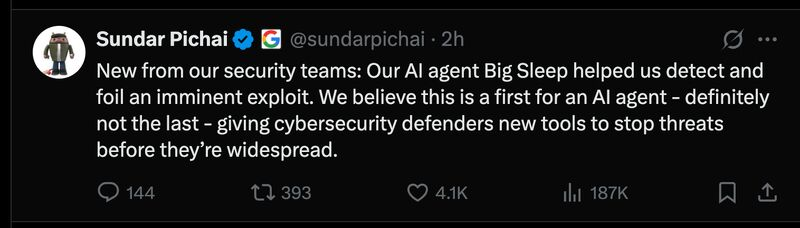
In a landmark achievement for artificial intelligence in cybersecurity, Google has announced that its AI agent "Big Sleep" has successfully detected and prevented an imminent security exploit in the wild. The AI agent discovered an SQLite vulnerability (CVE-2025-6965) that was known only to threat actors and at risk of being exploited. This breakthrough represents what Google believes marks the first time an AI agent has directly prevented a vulnerability exploitation attempt in the wild.
 Hacker Noob Tips
The Big Sleep Project: Architecture and Methodology
Origins and Development
Big Sleep was a collaborative effort developed by Google's zero-day hunting team Project Zero and its DeepMind AI research lab. The tool is an evolution of earlier versions of Google's framework for LLM-assisted vulnerability research known as Project Naptime, which was announced in June 2024. The project demonstrates the convergence of advanced AI capabilities with practical cybersecurity applications.
Technical Architecture
With Big Sleep, the idea is to leverage an AI agent to simulate human behavior when identifying and demonstrating security vulnerabilities by taking advantage of an LLM's code comprehension and reasoning abilities. This entails using a suite of specialized tools that allow the agent to navigate complex codebases and identify potential security flaws.
The system is built upon several key components:
Large Language Model Foundation: The Gemini 1.5 Pro-driven agent used variant analysis to discover the stack buffer underflow flaw. This demonstrates the power of advanced LLMs in understanding code patterns and identifying anomalies that could lead to security vulnerabilities.
Automated Code Analysis: The agent employs sophisticated code comprehension capabilities to understand software architecture, data flow, and potential attack vectors. Unlike traditional static analysis tools, Big Sleep can reason about code behavior in context and identify subtle vulnerabilities that might be missed by conventional methods.
Vulnerability Pattern Recognition: Through machine learning, the system has been trained to recognize patterns associated with common vulnerability classes, enabling it to identify potential security flaws even in unfamiliar codebases.
 Hacker Noob Tips
The SQLite Vulnerability Discovery
Technical Details of CVE-2025-6965
The vulnerability discovered by Big Sleep is particularly significant due to its potential impact and the circumstances of its discovery. The vulnerability in question is a stack buffer underflow in SQLite, which occurs when a piece of software references a memory location prior to the beginning of the memory buffer, thereby resulting in a crash or arbitrary code execution.
More specifically, Google's Big Sleep ultimately identified a flaw involving the function "seriesBestIndex" mishandling the use of the special sentinel value -1 in the iColumn field. Since this field would typically be non-negative, all code that interacts with this field must be designed to handle this exceptional case properly.
Impact Assessment
The specific vulnerability, tracked as CVE-2025-6965, is a memory corruption flaw impacting all versions of SQLite prior to 3.50.2. Memory corruption vulnerabilities are particularly dangerous as they can lead to a variety of severe consequences, including: Arbitrary Code Execution: An attacker could potentially execute malicious code on affected systems.
The vulnerability found by Big Sleep was a stack buffer underflow in SQLite, which could potentially allow malicious actors to manipulate data in ways that compromise database integrity. Discovered and reported in early October, the SQLite development team patched the vulnerability on the same day it was reported, demonstrating the importance of responsible disclosure.
 Hacker Noob Tips
Timeline and Response
Today, we're excited to share the first real-world vulnerability discovered by the Big Sleep agent: an exploitable stack buffer underflow in SQLite, a widely used open source database engine. We discovered the vulnerability and reported it to the developers in early October, who fixed it on the same day, showcasing the effectiveness of collaborative security research.
Preventing Active Exploitation
The Threat Intelligence Connection
What makes this discovery particularly remarkable is not just the technical achievement, but the timing and context. What makes this discovery extraordinary is that the vulnerability was "known only to threat actors and was at risk of being exploited," meaning malicious hackers had already identified the flaw and were preparing to weaponize it. Through a combination of Google Threat Intelligence and Big Sleep's capabilities, Google was able to identify and neutralize this threat before it could be exploited.
On Tuesday, Google said Big Sleep managed to discover CVE-2025-6965 — a critical security flaw that Google said was "only known to threat actors and was at risk of being exploited." This represents a significant shift from reactive to proactive cybersecurity defense.
Implications for Cybersecurity
The successful prevention of this exploit has several important implications:
Proactive Defense: Traditional cybersecurity has often been reactive, responding to threats after they emerge. Big Sleep demonstrates the potential for AI-driven proactive defense, identifying and neutralizing threats before they can cause damage.
Speed of Response: SQLite is an open source database engine, and the stack buffer underflow vulnerability could have allowed an attacker to cause a crash or perhaps even achieve arbitrary code execution. The rapid identification and patching of this vulnerability prevented widespread exploitation.
Democratization of Security Research: By automating certain aspects of vulnerability discovery, AI tools like Big Sleep could make advanced security research capabilities more accessible to organizations that lack extensive security teams.
Technical Innovation and Methodology
Beyond Traditional Static Analysis
Big Sleep represents a significant advancement over traditional vulnerability scanning tools. While conventional static analysis tools rely on predefined patterns and signatures, Big Sleep uses advanced reasoning capabilities to understand code behavior and identify novel attack vectors.
The system's approach involves:
Contextual Understanding: Unlike simple pattern matching, Big Sleep can understand the broader context of code execution and identify vulnerabilities that emerge from complex interactions between different parts of a system.
Variant Analysis: The Gemini 1.5 Pro-driven agent used variant analysis to discover the stack buffer underflow flaw. This technique involves analyzing variations of known vulnerability patterns to identify similar but previously unknown flaws.
Automated Proof-of-Concept Development: Beyond just identifying potential vulnerabilities, Big Sleep can develop proof-of-concept exploits to validate its findings, ensuring that reported vulnerabilities are actually exploitable.
Integration with Human Expertise
While Big Sleep represents a significant advancement in automated vulnerability discovery, it's important to note that it works in conjunction with human security researchers rather than replacing them. The system's findings are validated and contextualized by expert security professionals before being reported.
Broader Impact on the Cybersecurity Landscape
Shifting the Balance
The success of Big Sleep has important implications for the broader cybersecurity landscape:
Defensive Advantage: By providing defenders with AI-powered tools that can identify vulnerabilities before attackers exploit them, Big Sleep helps shift the balance toward defensive security.
Scalability: AI-driven vulnerability discovery can scale beyond the limitations of human researchers, potentially identifying vulnerabilities across vast codebases more efficiently than traditional methods.
Continuous Monitoring: Unlike periodic security assessments, AI agents can provide continuous monitoring of software for emerging vulnerabilities.
Challenges and Limitations
Despite its success, Big Sleep and similar AI-driven security tools face several challenges:
False Positives: AI systems may identify potential vulnerabilities that aren't actually exploitable, requiring human validation to distinguish between real threats and false alarms.
Adversarial Adaptation: As AI tools become more prevalent in cybersecurity, attackers may adapt their techniques to evade AI detection systems.
Resource Requirements: Advanced AI systems require significant computational resources and expertise to deploy and maintain effectively.
Future Implications and Development
Evolution of AI in Cybersecurity
The success of Big Sleep suggests several potential future developments:
Expanded Scope: Future versions may be able to analyze larger and more complex software systems, potentially identifying vulnerabilities across entire enterprise environments.
Real-time Protection: AI agents could eventually provide real-time protection, identifying and blocking exploit attempts as they occur.
Collaborative Intelligence: Multiple AI agents could work together to provide comprehensive security coverage, with each agent specializing in different types of vulnerabilities or attack vectors.
Industry Adoption
A research tool by the company found a real-world vulnerability in the SQLite open source database, demonstrating the "defensive potential" for using LLMs to find vulnerabilities in applications before they are publicly released. This demonstration of practical utility is likely to drive adoption across the industry.
Organizations may begin integrating AI-driven vulnerability discovery into their security workflows, potentially as part of:
- Software development lifecycle security testing
- Continuous security monitoring programs
- Threat intelligence and response capabilities
- Red team and penetration testing activities
Conclusion
Google's Big Sleep represents a significant milestone in the application of artificial intelligence to cybersecurity. By successfully identifying and preventing the exploitation of a critical vulnerability that was already known to threat actors, Big Sleep has demonstrated the potential for AI to shift cybersecurity from reactive to proactive defense.
The technical achievement of discovering CVE-2025-6965 in SQLite showcases the sophisticated capabilities of modern AI systems in understanding complex software systems and identifying subtle security flaws. More importantly, the prevention of active exploitation demonstrates the real-world impact that AI-driven security tools can have in protecting digital infrastructure.
As AI technology continues to advance, tools like Big Sleep are likely to become increasingly important components of comprehensive cybersecurity strategies. While challenges remain in terms of false positives, resource requirements, and adversarial adaptation, the successful deployment of Big Sleep suggests that AI-driven vulnerability discovery will play an increasingly central role in cybersecurity defense.
The collaboration between Google's Project Zero and DeepMind teams has produced not just a technical achievement, but a paradigm shift toward proactive, AI-enhanced cybersecurity that could fundamentally change how organizations approach digital security. As Google's AI agent, dubbed Big Sleep, has achieved a cybersecurity milestone by detecting and blocking an imminent exploit in the wild—marking the first time an AI has proactively foiled a cyber threat.
This breakthrough opens new possibilities for AI in cybersecurity and signals a future where artificial intelligence serves as a powerful ally in the ongoing battle against cyber threats. The success of Big Sleep is not just about one vulnerability prevented, but about the potential for AI to transform how we approach cybersecurity in an increasingly digital world.